Pinterest

FB Pixel

Pin it!

22.6.16

I HATE SIGHT WORDS!

There are SOOO many resources "out there" for teaching sight words, SOOO many lists, and SOOO many opinions on the matter that I thought I would add my thoughts to the mix...
And I HATE them!
There. I said it once and for all. I hate sight words. I mean, they break all the rules, they are easily confused, and they are a pain to assess and keep organized! As a teacher I hate feeling like a failure when we go over and over words like "the" and "what" and "said" and many of my Kinders or struggling readers still don't know them.  As a parent I feel pressure to suffer my own children through flashcards and list reviews just to be able to compete with other kids or earn a reward for finishing a set of words. As an interventionist I hate that my hard-working students' reading abilities are judged by the number of words they can call in isolation.

I'll bet you have felt some of those same things, but just didn't say them "out loud." So, if that's the case, then why oh why do we devote so much time and energy into teaching sight words?!?

Or maybe you think I'm crazy and you LOVE sight words?!? 
There are certainly many schools of thought on the matter.

Those who love sight words may believe some of the following:

  • Sight words are not decodable there for the only strategy for reading them is to memorize them.
  • Sight words (or more specifically high frequency words) account for more than 50% of printed material.
  • Knowing sight words with automaticity quickly improves reading rate and fluency.


I concede that these are all very good points and there must be a place for sight word instruction in our literacy curriculum. But, I oppose the notion that sight words must be learned in a rote manner and must be acquired at a mind-boggling pace in Kindergarten and First Grade. So, I present 

5. We are missing the bigger picture! When we emphasize memorization of whole words we tend to neglect the idea that words are made up of smaller sounds (or phonemes).  Young readers need to understand that words are  made of parts and when they know lots of parts they can figure out lots of words (without having to memorize them all).
4. We are unfairly judging our students. There are lots of ways to solve words and memorizing them is only one way.  If we classify, rank, or even reward our students for memorizing lists of words and equate quantity of memorized words to reading ability we are being very unfair. What about all the other ways readers solve words?!? Words can be solved through phonics, context clues, picture cues, and a strong grasp of oral language.
3. We are putting undo pressure on everyone!  The idea that Kindergarten students need to know X-number of sight words just causes stress.  Teachers, parents, and students should not feel stress or pressure to memorize words at a young age. That often just results in a lot of frustration for everyone that, if we really think about it, is unnecessary.
2. We are wasting too much time! It's hard to make time for sight word assessments because they take so long, they have to be completed one-on-one, and there are always a few words that need to be rechecked. We could probably find a much better use of our instructional time if we really stopped and prioritized.
1. We are instilling in our children that they have to "KNOW" all the words.  Nothing makes me more sad than for a struggling reader to tell me, "I can't read that story because I don't know all the words." Kids are perceptive.  When we pull them aside or send them in the hall over and over to review lists upon lists of isolated words... they know when they aren't "getting them" and they begin to believe that that CAN'T read because they haven't memorized the words.  They internalize this idea and think that reading is just memorizing... and they couldn't be more WRONG!

Have you joined me yet? 
Do you hate sight words, too? 
Are you still not convinced?

Either way, I'm issuing a challenge to reading teachers. As you are planning your next bit of literacy instruction replace time spent on sight word flash cards, sight word list reviews, and sight word assessments with... Reading! Beginning readers need to be paired with actual books that are on their level.  Books for early readers are rich in sight words and typically have patterned text.  Through repeated interactions with these texts students will vicariously learn sight words because they will be faced with them often.  But, instead of memorizing them in isolation, students will begin to recognize them in-context while reading and making meaning.  Learning words in this way will result in faster acceleration through reading levels and a more firm grasp of the words as they are encountered in a variety of ways. Students will be much more confident in themselves as a reader because they are learning through the act of reading.  Students will also realize that good reading means solving words using lots of strategies... not just memorizing them all.
After putting a stronger emphasis on and spending more time actually reading and less time memorizing words for awhile... Go ahead... assess your students using a list of sight words and I'll just bet that you will find your students (especially the struggling ones) know more of those pesky words with an even faster recall. Imagine that! *Wink, wink!

Be sure to check out my other posts on how becoming a reading interventionist completely changed my views on reading development and instruction!


26.4.16

3 Reasons Phonological Awareness is KEY

As a Kindergarten teacher I knew
Phonological Awareness to be the cornerstone to beginning reading skills.  As an interventionist I have learned WHY that is so.

First - What is phonological awareness?
Phonological Awareness is the understanding that words are made up of sounds and that those sounds can be manipulated (separated, changed, isolated, etc.)  Phonological Awareness IS NOT Phonics.  Phonics is the understanding that those sounds can be associated with printed letters.
An easy way to remember the difference is that Phonological Awareness can be taught in the dark.  It only requires listening for and producing words and sounds. Phonics cannot be learned in the dark because it addresses letters. BUT, Phonics cannot be learned without an understanding of Phonological Awareness. (More on Phonics Later!)
A sub-skill of phonological awareness is Phonemic Awareness. This is the understanding that words are made of a group of individual phonemes (or sounds).
Research shows that students can master Phonemic Awareness skills in about 20 hours of instruction and practice.  It is very important to provide opportunities for practice with each level on the phonological awareness continuum during the primary grades.

Second - Why is Phonological Awareness so important?
Phonemic Awareness in particular has implications not only in reading, but also in writing.  Once a child can articulate each sound in a word, he or she is ready to assign a letter (or letters) to those sounds in order to spell and write (that's where Phonics comes into play). Likewise, students who can segment words better understand how to blend sounds when reading.
For some students hearing the separation between phonemes (sounds) is very difficult. Delays in speech or hearing development can significantly complicate the process and they may need extra practice with the skill of articulation. HOWEVER, firming Phonemic Awareness skills is crucial to success in reading and writing.

Third - How can we teach Phonemic Awareness?
There are many different ways to practice phonemic segmentation with students, but one tried and true way is through the use of Elkonin boxes. To use these boxes students segment and push chips into a box as they say each sound.


I created these Elkonin boxes for my struggling Kindergarteners. After drawing the boxes, I added a pipe cleaner before laminating. The action of "pushing sounds" over the little bump was all it took to help them "feel" the breaks.
Watch as my daughter tries it out!

Here's a few other fun ways to practice phonemic segmentation!
Karate Chop Each Sound
Ride a Roller Coaster and go up/downhill on the middle sounds
Count sounds on fingers
Clap or tap sounds on desk/lap
Use exercises like toe touches or jumping jacks to physically move with each sound.


Phonological Awareness is KEY in literacy development because...
1. It provides students with a basic understanding of how words work before they begin to actually read and write.
2. When they understand that words can be manipulated, students begin to realize that words are made up of individual sounds in a specific order.
3. When students understand that words are made up of individual sounds and then "chunks" of sound they are ready to assign letters to those sounds.  This is writing! (And students are ready to learn to write while simultaneously learning to read! More on that later.)

Now watch as Leah segments and then assigns letters to each sound using her boxes.

ALL young students need practice with phonolgical awareness and it's a skill ALL students can and should master by second grade.
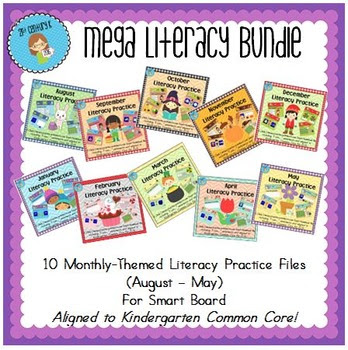
If you are looking for a way to add more practice with literacy skills into your school day and you have a Smart Board, then check out my monthly Literacy Practice files over at TpT!
(Files also sold separately here!)
https://www.teacherspayteachers.com/Product/NEW-MEGA-Literacy-Practice-Bundle-for-Kindergarten-1984659


11.4.16

Stop Saying, "Sound it out!"

You heard me correctly!  I said, "STOP telling readers to sound out words!"


When young children are reading aloud to us and come to a word they don't know or are unsure about we (teachers and parents alike) typically have one of two responses. Until my recent training in Reading Recovery (read about that here), I responded in these ways, too. BUT, I never really thought about what I was actually communicating to my students (and my own children) when I reacted in these two ways.


One knee-jerk reaction is to just tell the child the word with which he or she is having trouble. The other response we have is to tell the reader to, "Sound it out," when they come upon a new or difficult word.
 
Let's think about these responses together...
What are we conveying to students when we simply tell them the word with which they are having trouble?
Imagine if you were working to try a new recipe and Bobby Flay (or worse, Gordon Ramsay!) was over your shoulder watching your every move.  Would you be nervous or self conscious?  I would be! Now imagine that every time you stopped to consult the recipe, double check what you had added last, or went to the spice cabinet, Bobby swiftly stepped in and told you exactly what to do. For awhile this might be nice, but what if the next day you needed to make the same dish and Bobby wasn't there?!?  Would you remember what to do?  Would you have the same questions? More importantly, would you BELIEVE that you could recreate the recipe?  Probably not!  After all, Bobby is an expert chef and you are just a novice.

Think about how this applies to helping a young child read...
When we jump in and give words while children are reading we communicate that we are the "expert over their shoulder," and we don't believe they can figure out the word on their own. We provide a safety net that does NOT help to foster reading growth.  From our action children learn that if they stop or even hesitate THE EXPERT (us - not them) will be there to give them all the answers... if we continue this pattern, how can we expect students to EVER learn new words or know what they should do when that safety net is gone?!?


Instead of telling a reader the troublesome word immediately we should...
Wait (at least 3-5 seconds) AND Watch the child...
notice what he or she is trying alone so that you know how to jump in and help.
If the child is hesitant to try the word alone, prompt him or her to TRY something (really anything) such as look at the picture, read past the difficult word then go back, start the sentence again, etc.


BUT DON'T SAY, "Sound it out!"
When we prompt young readers to "sound out words," what are we really communicating to them?
We are essentially saying, "start at the beginning and say the sound each letter makes in order to solve the word." And when we use this phrase repeatedly we are really saying, "you should do this every time you come to a tough word because it is the only thing that works."
WHOA! Hold the phone!
If what we just said is true, then what about words with more complex letter combinations, silent letters, schwa sounds, affixes, and those dreaded SIGHT WORDS (man I really HATE those)?!?!
Research shows that accomplished 2nd grade readers attack words in over 60 different ways and most of the time they DO NOT start at the beginning and sound out words letter by letter.


Instead of telling students to sound out words we should...
Prompt children to use their eyes to search the difficult word for clues.
If the child is hesitant to try on his or her own or is unsuccessful, give specific clues within the word that may help such as digraphs, affixes, beginning sounds, words-within-words, etc.

NEW! Check out this accompanying YouTube video with teacher/student examples!


As we are helping young readers learn we have to remember our hope is they will gain skills so that the next time they read and we aren't there to help them, they will have the confidence and skills to solve new and difficult words ON THEIR OWN!


NOW, the next time you are listening to a young reader take note of your reaction to their struggles... When you are careful with your response what happens? Comment below and let me know - I can't wait to hear about your experiences!