Pinterest

FB Pixel

Pin it!

Showing posts with label Podcast. Show all posts

6.9.23

Daily Focus Slides in 21st Century Elementary

I still say PowerPoint is superior and there are many things PowerPoint can do that Google slides cannot just yet, but Google slides is a pretty close second. I started creating daily slides that I used with my online lessons, both to share over Zoom and also to send to families so that they could access the teaching content as well on their own time as they worked through assignments. The first slide in the slide deck would have all the expectations for the day, the things that they needed to have ready for our live lesson. It would have the cover of the book we were going to read and, of course, my cute Bitmoji, who was prepared for whatever content or season or holiday was around the corner, and I would post this at the beginning of each of my live lessons and from there I had other slides that I would go to that were made to look like classrooms for each subject area and that would sort of signify in a visual way that we were switching to new content, and also was a place for me to show things like anchor charts and vocabulary word definitions, as well as pictures of the worksheets that they needed to pull from their folder in order to work with me when I was live online. In addition, I could put pictures of completed worksheets so that when parents went back to that slide deck later, they would see what the answers to the questions were in order to better help their children. 

It was really a pretty cool thing, if I do say so myself, and when I went back to teaching kindergarten in person, I continued to use my slide deck resources. I mean, I had spent a lot of time on those and I had also done tons of research and found all kinds of slides that were made into libraries about different thematic contents or author libraries or activities or science videos. In fact, there are still more, or there are still bitmoji classroom groups on Facebook that are active today. If you join them, lots of people share free resources they've created. You just click it, copy it to your Google Drive and then you can access the slides to add them to your own slide decks and many of them are made to where you can edit them and use them as you see fit. 


So because I had created this vast collection of slides, I thought well, why can't I use this to help me in the in-person classroom? I posted my daily or weekly once I was in person morning slide that had the letter we were studying the book we were reading, the lunch choice for the day and all kinds of other things listed along with my cute bitmoji, and this would be posted when the students would come in the classroom each morning. Behind that, I would have linked up a slide for each subject area and also slides with those cool libraries and videos that I talked about before. Then I could project this and talk a little between the slides and access any of the content that I needed at any given time during the school day. It became really, really useful in the classroom. 

So when I moved to fourth grade, I continued. I definitely still have my first slide and I still use my bitmoji, even though it's kind of cheesy, and I have a slide for each day of the week, but it looks a little different For the big kids. I have listed the activities that we're going to do for the day. I have my ICANN statements and my guided questions, guiding questions, guided guided questions. Easy for me to say Sorry, my guiding questions posted, but I also link up whatever texts we're going to be reading. I have a 10 minute timer that comes in really handy for journal entries and other things like that. On my morning slide for my homeroom I link to our school news and so I can get that with a click and show it to my students and include the lunch choices and just all that good stuff. It really makes the transition to reading class easy because it's popped up on the board and there's no guessing what will happen in class that day. Students can come in, look at it and know what the expectation is going to be. But organizing my day is not where these daily focus slides end. 

I really, really liked when my online families back during the pandemic could access those slides and use them at home. So when I taught kindergarten in person after the pandemic, I would link my slide deck in my daily emails and it became really great for families to click and go in. They could review concepts and contents, they could watch video lessons, their students could click and read some of their digital guided reading books to their families and it was a great way for families to make connections with what we were learning in school. I continue to do the same thing in fourth grade, sharing my slide deck with families every week. It's wonderful for the older kids because if a student is absent or gone on a trip, they are able to access each daily plan and also access the text that we're reading, because I try to include a YouTube link for each book that I'm going to be reading, which is super handy when I don't have a copy of the book or I need to speak with someone, but the class needs to keep going forward or I lose my voice and don't feel well and feel like reading that day. 


It's nice to have all of those digital links right there handy for myself and for my students and their families, but I also share these slide decks with my collaborative teachers, with substitute teachers and with my administrator. There's no question what is going on in my classroom and I have one place for my co-teachers, collab teachers and anyone else who comes in the classroom to access and view and help students with what we're working on. It's really become an important part of my lesson planning. In fact, because I love Google slides so much, now I even do my lesson plans on Google slide and each week I link to that slide deck. It's so wonderful when we can create systems to help ourselves in the classroom that we can use over and over again, and that's why, after taking the time to create these slide decks last year, I'm reaping the benefits my second year and fourth grade when I go to that file, pull up the slide deck for the week, check the links, make a few tweaks, change the day and I am ready to go each Monday morning. The time saved is well worth the work that I put in on the front end creating them the first time. Aside from just keeping me on track while I'm teaching, my daily focused slides help my students stay focused on the lesson when know their expectations, and they help my families be able to connect to our education my co-teachers and collab teachers to access what we're doing each day, my administrators, if they want to keep tabs on my fourth grade classroom, and even my substitute, when they come in, has access to everything that we're doing that day. It has been a huge help in my classroom and if you don't use daily focused slides, I highly encourage you to start. Start with one, see how you like it, and I guarantee you'll be adding to them and saving them year after year, just like me. Thanks for listening. 

Hey, have you ever thought about making your own interactive slide decks? Maybe the thought has you feeling overwhelmed because you don't understand the technology, or there are just so many options you don't even know where to begin. Well, don't worry, I've got you. I am working on an interactive slides masterclass, a one-time course you can take at your own pace to learn all the tips and tricks I know for creating interactive slide decks that you and your students will love. We'll talk about how to create interactive slides like my calendars and literacy reviews, and also daily focus slides that you can use in your classroom every day of the school year. We'll even talk about how you can come up with your own ideas to create slides that you can sell yourself. I mean, if we're going to do all this work for our own classrooms, why not help other teachers and make a little passive income on the side, right? CLICK HERE to learn more about 21st Century K's Interactive Slides Masterclass!

27.8.23

Student Keepsakes in Kindergarten


In kindergarten especially, student keepsakes are a big deal. When I think about my kindergarten plans, I know that there are certain times in the year when we're going to be creating and making and saving things to send home to families, and that's a big deal for me as a teacher and also as a mom to have something to save and look back on. But as a teacher and a mom, that can also be very overwhelming. Some families will keep every single piece of paper that we send home and some families won't keep any and they'll rely on us to do the saving of the special things to send to them. So I came up with the system my last couple of years in kindergarten that really helped with all of that and also had purpose in my classroom I started coming up with weekly writing and art activities and I use them in a multitude of ways. But as far as the keepsake portion goes, I would save these weekly activities for the whole entire year and then put them together in order and bind them and give them to families as their big book of kindergarten keepsakes. And it's something that as a mom, I totally would have appreciated because it's done, it's put together and I didn't have to try to keep up with things over the course of the year. So my goal was to help families to be able to save something from their kindergarten year, but also help myself as a teacher and make sure that we are continuing to meet our standards and grow our students while also creating some quality work and some things worth saving, because, let's face it, every single math worksheet isn't necessarily worth saving. So this is how I complete this, and my husband still does this today in his kindergarten classroom, and his families really enjoy getting this at the end of the year. 

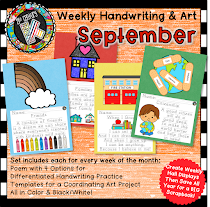
Every week my students complete some sort of writing task. I use this as a handwriting practice for the first part of the year, where students might trace a poem or a sentence or they might copy it if they're developmentally ready for that. They might also have some open-ended writing prompts or some fill-in-the-blank type writing prompts as the year goes on and I pull these prompts from our thematic units of study, so inevitably they go with the seasons and they go with the special days and holidays, and so it gives a very easy glance at the course of the year when you put them all together. In addition to those writing activities, we do an accompanying art activity, and this may be as simple as following the directions and coloring and cutting. It may be using different types of art media like paint or collage with glue, and it also goes with the theme and goes with the handwriting. So I automatically have built in for myself, every week of the year, a multitude of things. 

I've built in a writing activity, slash handwriting activity, however I so choose to use it, that I can differentiate. I have built in an arts and crafts activity that's all thematic based. I have built in these projects that I can do with my students in different ways. So some years I do some more broad learning centers where students work on different things different days of the week. So one center would automatically be handwriting and one would automatically be art, and so we'd have these things completed by the end of the week. There have been other years, especially during the COVID days when we couldn't work in small groups, that the entire class would work on handwriting one afternoon a week and the entire class would complete art projects, or maybe a few students at a time would pull to the table and work with my assistant if it was a more complicated art project. But they're very versatile, very easy activities that I can work into my week. 

I can know that I am able to differentiate. I can know that I am able to do activities that go with my theme. It's thundering here right now, I don't know if you can hear that, and I know that I have something already planned and prepped for the week. I mean, how great is that? And then comes the magic. I take a 12 or 18 by 24 piece of construction paper I invested in a lot of that before the school year starts and I glue the handwriting at the bottom, with the page vertical and the handwriting activity is usually landscape and then at the top I attach the art project. These work displays then can hang in the hall under each student's name and picture for the duration of the week. So now I have differentiated activities. I've included handwriting and art, I've included optional centers and whole group activities and I have hallway work displays that go with the theme, and I know we're going to constantly be changed out when I complete them every week. That's huge. I mean, there's nothing more embarrassing than glancing at your art displays in the hall and realizing that you still have fall leaves and it's snowing outside. This way I have a schedule and rotation for what I'm displaying in the hall so that my displays are current and that kids are seeing that what they do matters and it's going to be shown, and when parents visit there's something fresh for them to see. Administrators love it too, and so I have that already built in to my weekly plan. I don't have to think about it or do anything extra special, unless I just so choose to. 

The last part of the magic is when I save them. I did these types of art and handwriting displays for years and would send them home every week, and then one year I thought wait, a minute, I am missing an opportunity here. When I send these home every single week, parents are probably fumbling with a place to save them or, to be honest, throwing them out. What if I saved them? I kept them in order, I bound them and then presented the families with them by the end of the school year. So that's exactly what I started to do. I saved the displays for the whole entire year and they make a big 18 by 24 book. I punch holes in the sides and use jump rings to attach them. You could get really fancy with ribbons and you could do a cute cover where kids color in the words kindergarten keepsake, or you add some photos. However you so choose to do, it is up to you. But the thing is, when you get to the end of the school year. You don't have to make anything except the cover. You just keep them stored in a cabinet and keep them in order and bind them and, boom, you have an awesome kindergarten keepsake for the end of the year. 

I've been brainstorming ways that this same type of thing can be done in other grades and I would for sure do this if I taught first or second or even third grade. I would just change out what I was doing so that it was age appropriate. But you know, every week I'm probably going to have a writing assignment and every week I would love to have an art activity. So this would be a way to incorporate those things into my plan and plan for the end of the year, while also having some displays and some key keepsakes too, and meeting my standards as a fourth grade teacher. I've really thought about this because I would totally love to make something like this for my students. Last year it just really didn't fit on my teacher plate. You know what I mean. 

But this year I'm brainstorming ways to create something like this. I would love to take time out of my reading class to add art. I just think anytime you can involve the arts in your learning, it helps all students deepen their understanding, have a creative outlet and make connections with what they're learning, and so my goal for this year is to come up with those activities as I go through the school year and maybe, instead of weekly, I'll have something for each unit of study so that at the end of the year we can put them together in a binder or folder or some other easy publishing way to send home with family so that they have something to save for their fourth grade year. Because, as my principal tells me or reminds me, the fourth grade at my school is the kindergarten of the elementary school. That's why I feel like it's kind of been a great transition for me and kind of been a perfect fit. 

Maybe you teach fourth or fifth grade and you're in a K-5 elementary school. You could definitely think of ways to include what you hang in the hall in a keepsake folder that you give to families at the end of the school year. It has tons of benefits and will be something that your families will always treasure. And, as we've been talking about, making positive connections with students and families is really what it's all about and really what makes for a successful year. Thanks for listening. Do you teach kindergarten or maybe first grade and you're interested in the handwriting and art activities that I do, I would love to share them. If you'll check in the show notes, I'll link to my TPT store where I have four art activities and four writing activities for every month of the school year, august through May. You can grab those, start printing and start creating your end of the year keepsakes this week. 


13.8.23

Lesson Plans in the 21st Century

 Lesson planning is a huge part of being a teacher. I mean, you can't just walk into a classroom and start teaching children without a plan.

You have to know what you're going to say, what information you're trying to convey to your students, the resources that you're going to need have to be on hand and your activities have to be prepared. You have to know your standards in order to be able to plan activities and then reflect to make sure that the way you're delivering your instruction is working for your students and that they're learning and their growing planning lessons is a big part of what we do. And it is so important to do it well.

And for many years, lesson planning was just the same old thing. You might work a week in advance or you might work on Sunday night before Monday. Whatever the case, teachers put their plans down in an old school plan book or maybe even on a personal e-mail template, maybe even on an online template that had to be turned in or saved from year to year. I know when I was in college, we wrote those six page lesson plans for a one 20 minute activity, and we quickly found that in the real world, that was impossible. And we learned all about the shortcuts in the shorthand for writing lesson plans that would be helpful to us personally in the classroom and also to us in the event that we weren't there.

But lesson planning came to a screeching halt on March 13th. Anything that any of us had planned for the 16th was out the window on March 13th, 2020, I walked out of my classroom not knowing what to expect in the weeks and months to come.

We had hurriedly prepared some packets based on our plans for the next week or two to send home with our students so they would have activities. We started quickly learning how to communicate more via the Internet and deciding how we were going to reach our families and stay in touch with them during such an unprecedented, uncomfortable and uncertain time. The lesson plans that I left on my desk that day ended up meaning nothing. And then the lesson plans that I made from that point forward, oh, they were just jotted notes here and there and maybe a pile of activities I wanted to get to or an email I would send to myself with something I found on the Internet we might be able to do over a zoom meeting.

And then two weeks became four weeks, became six, became eight. And the next thing I knew, we were finishing out the year and the last several weeks of my planning book were empty. It really caused me to reflect about lesson planning and really on a deeper level, planning for life. We were supposed to head to Florida for spring break in the spring of 2020, and that didn't happen. All kinds of plans fell through for everyone. And it really makes you stop and take inventory and think about whether or not you're living in the future or living in the moment. When it comes to making lesson plans, there are a few key things that we need to do to stay ready in the year 2020, when my school year started, all of the school district was online.

So our lesson planning was completely different than how it had been the year before.

We could not do all the same activities.

We didn't have centers and choices for play or hands-on manipulatives.

We were sending home some worksheets and prepping online activities, something that went completely against the grain of myself and my entire team.

We were going back to the basics when it came to planning our lessons in so many ways, but at the same time having to be incredibly innovative and try new things. After a few weeks, some students came back to school and some stayed online, I've been teaching kindergarten online since August and while it is hard work, I'm really enjoying it.

And I've learned that planning this year is different. And in turn, lesson planning for me will be different from here on out. It's funny how these things happen in our lives that we think are going to be a challenge we think are going to be difficult and they cause us to grow and stretch and change in ways that we never thought we would. And in the end, we can come out ahead and better for it. When we look for the silver linings and lesson planning has been a silver lining for me. I've learned through this time that lesson planning in an uncertain time has to be both short and long term.

And that may seem simple, but if you do not have a long range scope and sequence plan for your year, it will make it very difficult to chunk that out so that you can make short term plans in order to address the needs you have at the moment. What I mean by that is my team has a plan for every subject for every week of the year that we carry forward. Every school year we go back and revise based on the calendar dates, and we may make changes when there are changes in our standards or in preferences about what we teach or like this year, when we learn how to teach better, we are starting from the same place with our long range scope and sequence. So having that has made planning easier. If you don't have a scope and sequence of plan, I urge you to create one. It's something you could spend all summer on, or you could work on it a little over the course of the school year. And by the time the year ends, you'll have something for the following year.

But once you get all that information in one place that you can refer to and go back and see that all of your standards are covered, all of your core tier one instruction is covered and planned and mapped out, then you'll be able to breathe a little and be able to make decisions in the shorter term about prioritizing your lessons, choosing your activities and planning for an uncertain time.

That's where the short term plan comes in. We have always planned a week in advance and in this situation that's just not working. So my team has been planning upwards of two weeks in advance so that at any given moment we are prepared with a game plan for the following two weeks and that short term plan isn't fancy. It might be on a Post-it or jotted on and out. But we know what the plan is for the next two weeks with a little more detail and to where we could put things together to switch gears and pivot on what we're doing at a moment's notice. For instance, right now, we just finished week seven. We have week eight already in the works planned in the books, activities prepped, copies made. My students are at home. They have what they need. Students in person and teachers in person are prepared as well. But in the meantime, we also have weeks, nine and ten mapped out with activities selected and in the process of copying and prepping the things we'll need for those, it takes a lot of thought to. Keep these short term plans up to date and a lot of prep time on the front end, however, if something happens in the next few days and we need to switch gears and all go online or switch to a hybrid model, or if my children all come back in person, we will be ready.

And I can not begin to tell you the peace of mind that that gives me and my entire team. So you need a long term plan to go to to make sure that everything's mapped out and everything's going to be covered. And in the meantime, during this time when we don't know what the next two weeks may hold, it's important to have a two week short term plan to get everything prepped and ready to go on a moment's notice in any direction. 

The thing that has really made a difference in my lesson planning this year is that I've finally gone digital. I know it's funny that I talk about bridging the gap between old school and 21st century when in so many ways I am still so old school. That's because old school works. It's tried and true. And I love a teacher plan work and my number two mechanical pencil.