Pinterest

FB Pixel

Pin it!

Showing posts with label Phonological Awareness. Show all posts

18.8.16

No More ABC Flashcards!

When I learned about using an Alphabet CHART instead of flashcards at my last reading interventionist training I thought, "This is SO simple and makes SO much sense! Why didn't I think of this?!?" Of course any mind-blowing thing I learn I have to share... I believe we should ALL share ideas and resources... interventionists and classroom teachers are all on the same team. 


Using an Alphabet Chart instead of flashcards for practicing letters fosters lots of pre-reading skills:

  • Concept of Word vs. Letter
  • Tricky Sight Word "the"
  • Left-Right Directionality
  • Top-Bottom Directionality
  • 1:1 Correspondence
  • Tracking
  • Using Picture clues
  • Text-Wrapping
Can ABC flashcards do ALL THAT?!?

Of course, I couldn't share this awesome tidbit 
and leave you empty-handed!
Grab a FREE Alphabet Chart for your students HERE! 


26.4.16

3 Reasons Phonological Awareness is KEY

As a Kindergarten teacher I knew
Phonological Awareness to be the cornerstone to beginning reading skills.  As an interventionist I have learned WHY that is so.

First - What is phonological awareness?
Phonological Awareness is the understanding that words are made up of sounds and that those sounds can be manipulated (separated, changed, isolated, etc.)  Phonological Awareness IS NOT Phonics.  Phonics is the understanding that those sounds can be associated with printed letters.
An easy way to remember the difference is that Phonological Awareness can be taught in the dark.  It only requires listening for and producing words and sounds. Phonics cannot be learned in the dark because it addresses letters. BUT, Phonics cannot be learned without an understanding of Phonological Awareness. (More on Phonics Later!)
A sub-skill of phonological awareness is Phonemic Awareness. This is the understanding that words are made of a group of individual phonemes (or sounds).
Research shows that students can master Phonemic Awareness skills in about 20 hours of instruction and practice.  It is very important to provide opportunities for practice with each level on the phonological awareness continuum during the primary grades.

Second - Why is Phonological Awareness so important?
Phonemic Awareness in particular has implications not only in reading, but also in writing.  Once a child can articulate each sound in a word, he or she is ready to assign a letter (or letters) to those sounds in order to spell and write (that's where Phonics comes into play). Likewise, students who can segment words better understand how to blend sounds when reading.
For some students hearing the separation between phonemes (sounds) is very difficult. Delays in speech or hearing development can significantly complicate the process and they may need extra practice with the skill of articulation. HOWEVER, firming Phonemic Awareness skills is crucial to success in reading and writing.

Third - How can we teach Phonemic Awareness?
There are many different ways to practice phonemic segmentation with students, but one tried and true way is through the use of Elkonin boxes. To use these boxes students segment and push chips into a box as they say each sound.


I created these Elkonin boxes for my struggling Kindergarteners. After drawing the boxes, I added a pipe cleaner before laminating. The action of "pushing sounds" over the little bump was all it took to help them "feel" the breaks.
Watch as my daughter tries it out!

Here's a few other fun ways to practice phonemic segmentation!
Karate Chop Each Sound
Ride a Roller Coaster and go up/downhill on the middle sounds
Count sounds on fingers
Clap or tap sounds on desk/lap
Use exercises like toe touches or jumping jacks to physically move with each sound.


Phonological Awareness is KEY in literacy development because...
1. It provides students with a basic understanding of how words work before they begin to actually read and write.
2. When they understand that words can be manipulated, students begin to realize that words are made up of individual sounds in a specific order.
3. When students understand that words are made up of individual sounds and then "chunks" of sound they are ready to assign letters to those sounds.  This is writing! (And students are ready to learn to write while simultaneously learning to read! More on that later.)

Now watch as Leah segments and then assigns letters to each sound using her boxes.

ALL young students need practice with phonolgical awareness and it's a skill ALL students can and should master by second grade.
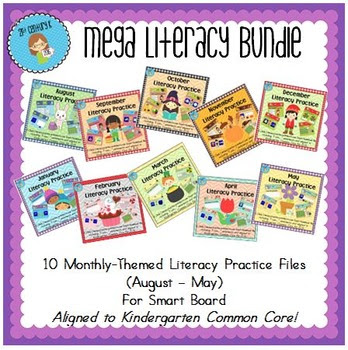
If you are looking for a way to add more practice with literacy skills into your school day and you have a Smart Board, then check out my monthly Literacy Practice files over at TpT!
(Files also sold separately here!)
https://www.teacherspayteachers.com/Product/NEW-MEGA-Literacy-Practice-Bundle-for-Kindergarten-1984659


8.4.16

What I've Learned as a Reading Interventionist: Year 1


This year I have taken a detour in my teaching journey and moved out of the Kindergarten classroom (hence my poor, neglected blog). It has been a bittersweet time for me. I am in a position now that is more focused and doesn't have the same requirements and demands of a self-contained homeroom. As a result, I am able to focus on my own three precious kids (ages 9, 6, &3) more, spend less outside-the-school-day hours working on school, easily attend my girls' school events, and take sick days at a moment's notice when I'm needed at home. Don't get me wrong, these changes FAR out-weighs any downsides to the position, but I miss my kinders all the same. At certain times during the school year I have missed the milestones, the relationships with students and parents, and the honor of working to provide a wonderful first-year-of-school experience. Watching my students from last year as they have grown through first grade has brought me to tears of pride at times and I cherish the tackling hugs I receive as I walk the first grade halls. 
BUT...
I have learned SOOOOOOOOO much as a reading interventionist (in training)!  Even after 5 years as a first grade teacher, 5 years as a Title I interventionist, and 3 years as a Kindergarten teacher, what I have learned THIS year about reading instruction has shaken my beliefs about reading to the core, and I'm bursting at the seams to share it all with YOU!  I am excited to share some insight on reading instruction based upon what I've learned. I WISH someone would have shared these ideas with ME as a primary teacher. So, this post is meant to kick off a series of posts for parents, homeroom teachers, and interventionists in the primary grades, that focuses on some 
best practices for guiding a child through the wonderful world of learning to read.

Stay tuned for posts on the following topics - 
Do YOU have burning questions about any of these topics?  
Post them in the comments below and I will work to address them!
Be sure to sign up for our newsletter set to launch in April, 2016, so you don't miss a single update AND to gain access to new freebies!  

Now for the fine print...
I'm sure you are wondering where I gained all this amazing insight! Since July, 2016, I have been involved in intensive training in the research-based, Reading Recovery Program that was developed by Marie Clay. According to the RRCNA website, the goal of Reading Recovery is "to dramatically reduce the number of first-grade students who have extreme difficulty learning to read and write." RR teachers work one-on-one with first grade students who are struggling with literacy as identified through assessment data and teacher recommendation. My year-long training has been hands-on in that I have been working with students while learning the program. *Please note that these blog posts are NOT intended to (nor could they) make you a RR teacher, nor should they give you tools that may be mis-used if you are untrained. The RR program is successful because it's processes and procedures are precise and protected. To remain a true RR interventionist, teachers must participate in continuous training and professional development while putting the program into practice. They must be observed and critiqued by their RR teacher peers and their highly-trained teacher leaders.  This thoroughness leads to a program with high fidelity, huge success, and perfected practices. If you are interested in being trained in RR check out the "Training" section of their website or check out how RR can help your school's RTI Program here!

HOWEVER...
Since I am fresh from a primary classroom and my eyes have been opened to new ways to approach reading this year, I just can't keep quiet about some of the things I have learned because I KNOW they will help YOU with YOUR literacy instruction!

Looking for the perfect printable (and online) leveled Kindergarten books for your guided reading lessons? Then look NO further.

Head over to my TpT store for my growing library of printable leveled books for Kindergarten Guided Reading!

20.3.15

Post at The Literacy Ladder

Head over to The Literacy Ladder to check out my post on a great Phonemic Awareness program!
And don't forget to join in our weekly Linky Party "WOW Me Wednesday!"
Share your favorite products, freebies, and/or blog posts and WOW us!