Happy St. Patrick's week! It's week 29 in Kindergarten and time for more science exploration and fun. This is quite possibly one of my favorite weeks of the school year! Check out the fun we've had in past years HERE!
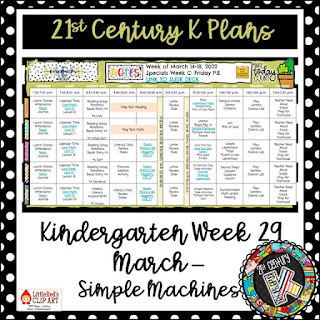
3 Big Goals:
Spring MAP Testing
Complete Report Cards
Schedule Parent-Teacher Conferences
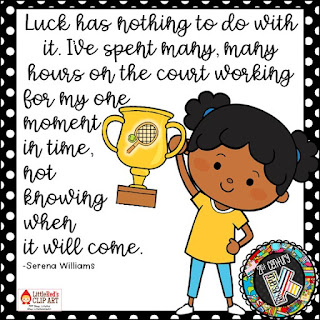
Famous Words:
"Luck has nothing to do with it. I've spent many, many hours on the court working for my one moment in time, not knowing when it will come" -Serena Williams
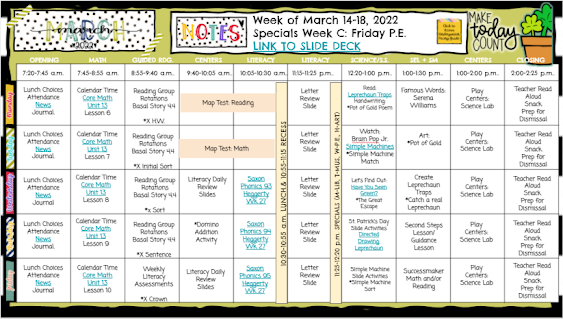
My students have LOVED the Science Lab and Maker Space this last week. I have LOVED seeing their creativity and ingenuity! This week we will expand our unit on Force and Motion to cover Simple Machines and then use that knowledge to create Leprechaun Traps. It's always so fun to see how they plan their traps. This time of year is really magical and bittersweet in Kindergarten. I can see how far my students have come, see their potential for the future, and, yet, I know my time when them is winding down. In core math we are continuing our new unit on subtraction while continuing a review of measurement. We will use several hands-on activities to practice measuring length with both standard and non-standard tools. In literacy we are pressing on with Saxon Phonics, Heggerty Phonemic Awareness, and with basic sight words.
St. Patrick's Day is a time for light-hearted fun and traditions in Kindergarten! We will explore some fun books this week:
Are you ready to start guided reading groups, but still feel uncertain as to how to sort your students... even with all that beginning-of-the-year-data? We've all been there!
Using a student's Fluency (fast or slow) and Accuracy (right and wrong) rates when reading a grade level passage, it's easy to sort your students into four distinct groups for guided reading instruction. After I learned about this way of sorting students at a wonderful training with the 95% Group, I started thinking about what my instruction might look like for each type of reader. In this Virtual PD video series we will explore the four types of readers, their characteristics, their strengths as readers, and the implications on their instruction. Before starting this Virtual PD be sure to download and print this FREE Handout for note taking!
It's that time of year again! It's time to get to know our students and gather all that baseline data so that we can monitor growth, pinpoint struggles, and search for ways to challenge our students. When it comes to reading our assessments can run the gambit from computer based tests, to timed fluency assessments, to paper-pencil tasks. BUT, do these sorts of assessments REALLY tell us how our students read?
Do you want to really KNOW your students as readers?
Would you make time for an assessment for your students that could tell you...
About their fluency,
About their expression and phrasing,
About their problem solving strategies,
Whether they attend to punctuation,
Whether they use picture clues,
How well they know sight words,
How they attack new words,
If they are reading on grade level,
If they read with accuracy,
AND
Their level of confidence about reading in general???
Of course you would! And it's really VERY simple!
WOW! We can learn SO MUCH about our students just by taking the time to listen to them read!
It's worth the time and effort because listening to our students read is the only way to truly assess their reading on an individualized level. Do you make time to listen to your students read?